North Carolina
North Carolina lacks a historic Lithuanian community or heritage, however, there are Lithuanians who moved to live in the Durham/Raleigh area that is strong in science and technology.
Since 2013, a distillery of Lithuanian krupinkas operates here (Brothers Vilgalys Spirits). It also provides other alcoholic drinks and it was envisioned by Rimas Vilgalys, himself a son of a Lithuanian-American father who used to distill krupnikas in his home.

Vilgalys Bros distillery (exterior)
With relatively few local Lithuanians and laws limiting interstate sales, Vilgalys Bros krupnikas distillery mostly sells to non-Lithuanians who seek new alcoholic tastes. Before the COVID pandemic there were also tastings and distillery tours on offer.

Bottles of krupnikas

Distillery interior with a Lithuanian flag
Map of Lithuanian heritage in western Midwest

Map of the Lithuanian heritage in Western Midwest (Illinois, Wisconsin and Indiana).
More info in Lithuanian heritage in Illinois, Indiana, Wisconsin.
Map of Lithuanian heritage in eastern Midwest

Map of the Lithuanian heritage in eastern Midwest (Michigan, Ohio) and western Ontario.
More info on Lithuanian heritage in Ohio, Michigan, Ontario.
Map of Lithuanian heritage in Mid-Atlantic

Map of the Lithuanian heritage in Mid-Atlantic (New York, New Jersey, Pennsylvania, Maryland, DC) and western Ontario.
More info on Lithuanian heritage in Maryland, New Jersey, New York, Pennsylvania, Washington, DC, Ontario.
Map of Lithuanian heritage in New England

Map of the Lithuanian heritage in New England (Connectictut, Massachusetts, Maine, Rhode Island, New Hampshire) and Quebec.
More info on Lithuanian heritage in Connecticut, Maine, Massachusetts, New Hampshire,
Rhode Island, Quebec.
Oklahoma
When the Lithuanian mass migration to the USA began ~1865, Oklahoma was still the Indian Territory.
However, in the decades afterward, it has been colonized and developed by the Americans. Coal mining began. Higher salaries attracted Lithuanian miners from Pennsylvania to those far-away regions.
The center of the coal mining was around the town of Hartshorne (also in Wilburton, McAlester, etc.). In these towns, Lithuanian communities developed – however, they were not large or cohesive enough to build their own churches or clubs.
Thus, currently, the Lithuanians of Oklahoma are reminded solely by inscriptions. Most of such inscriptions are located in the Holy Rosary Catholic Cemetery of Hartshorne. It has an area where all the graves are those of Lithuanians (at around 34.86192725312656, -95.55367835119232), however, it is not anyhow marked and other Lithuanian graves appear all over the cemetery. Tombstones are large just as they are in Lithuania. Epitaphs describe the birth and death dates and locations, as well as the Lithuanian fraternal organizations the deceased were members of (these organizations often helped to pay for the funeral).

A line of old Lithuanian graves in Elmwood Cemetery of Hartshorne
There are Lithuanian graves in the area‘s other cemeteries but they are not concentrated – e.g. Calvary cemetery of Wilburton.

A Lithuanian grave in Oklahoma
In front of the Wilburton Calvary cemetery entrance (on the opposite side of the road) there was a separate Lithuanian non-religious cemetery (owned by the Lithuanian Alliance in America). However, merely a sole gravestone with Lithuanian symbols survives there in what is now a meadow. Much of the original burials may have been under what is now the road. This cemetery would have likely been forgotten if not for the research by Vilnius Žalpys from Portland, Oregon. Even today, it is beyond a barbed-wire fence.

The former location of the Lithuanian cemetery behind a barbed wire fence. The sole remaining gravestone (with Lithuanian coat of arms) is marked by posts.
In 1981, the Hartshorne school has been renamed Buzidragis Middle School after a Lithuanian Buzidragis who served as that school‘s principal for 25 years. He was not a descendent of the Oklahoma miners, however – rather, he moved from Lowell, Massachusetts, where he was born to a Lithuanian family. His name is written on the school facade, on a stone next to a tree planted for him. His picture is in the hall near the school entrance. According to the locals, Buzidragis was loved by the people of the town for being just and he didn't evaluate people based on their race. Buzidragis family's original Lithuanian surname was Bažadragis.

Buzidragis Middle School
Lithuanian names also appear on the Coal Miners Memorial Plaza in McAlester which lists miners killed in many accidents of the area where coal mines were especially unsafe. The memorial lists all the victims behind a statue of a miner.

Coal Miners Memorial Plaza in McAlester
Atlanta, Georgia
Atlanta, Georgia was the home of 1996 Summer Olympic Games. The Games are commemorated in its central Cetennial Olympic Park that is full of memorials reminding Olympic games. Three of these memorials also have Lithuanian details.
Quilt of Olympic Spirit has the names of every Olympic medal winner inscribed on them. In Atlanta, the Lithuanian National Basketball Team has won bronze medals, so 12 of these names are Lithuanian: Arvydas Sabonis, Rimas Kurtinaitis, Darius Lukminas, Saulius Štombergas, Eurelijus Žukauskas, Šarūnas Marčiulionis, Mindaugas Žukauskas, Gintaras Einikis, Artūras Karnišovas, Rytis Vaišvila, Tomas Pačėsas. Unfortunately, the time has made some of them barely legible.

Some of the names of the 1996 Lithuanian National team basketball players on the Quilt of Olympic Spirit in Atlanta
Another memorial is dedicated to the Paralympic games that took place in Atlanta right after the Olympic games concluded. There, 8 Lithuanian athletes are inscribed as they have won medals (7 in athletics and 1 in judo). The athletes are listed by sport, then by surname (alphabetically) and their names are written in the color of the medal they have won. The commemorated Lithuanian Paralympic medallists are Aldona Grigaliūnienė (gold, long jump), Malda Baugartė (gold, discus throw and shot put), Kęstutis Bartkėnas (silver, 5 km run), Vytautas Girnius (silver, javelin throw), Saulius Leonavičius (bronze, 1500 m run), Kęstutis Bartkėnas (bronze, 10 km run), Rolandas Urbonas (bronze, shot put), Sigita Markevičienė (bronze, 800 m, and 1500 m run), Jonas Stoškus (bronze, judo 78 kg). Aldona Grigaliūnienė has only her initial inscribed as her name was too long.

A part of the memorial that includes Saulius Leonavičius surname
The third Lithuanian-related monument is the Quilt of Nations, the ceiling of which includes the flag of every country that has participated in the 1996 Atlanta Olympic games. They have been added alphabetically and so the Lithuanian tricolor is between Liechtenstein and Luxemburg.

Quilt of Nations memorial

The ceiling of the Quilt of Nations memorial
Currently, Atlanta is the largest city in the southeastern USA. As such, it has attracted numerous Lithuanians (~2000), both new immigrants from Lithuania and Lithuanian-Americans from other parts of the USA, who have transmigrated to Atlanta from the Northeast or Midwest because of work or business opportunities. However, as this external or internal migration happened relatively recently, there is no traditional Lithuanian heritage in Atlanta or Georgia (Lithuanian churches, clubs, cemeteries, etc.).
Reading, Pennsylvania
Reading city has a white Lithuanian St. Anthony church. The building does not look like a church from the front, however, it certainly looks like a church from the side. That's because a regular building was acquired by Lithuanians in 1913 and put into church use. While the community remained for a long time and was still an officially Lithuanian parish at the end of the 20th century, actually, non-Lithuanians joined it quite quickly and so Lithuanian details likely disappeared long before the church was closed. In 1920, for example, Reading had only 54 Lithuanians.

Reading Lithuanian church
The map
All the Lithuanian locations, described in this article, are marked on this interactive map, made by the "Destination Lithuanian America" expedition (click the link):
Saginaw, Michigan
Saginaw attracted some Lithuanians before World War 1 as a major center of timber industry. Some 60 families separated from a Polish parish in 1918, establishing their own St. George parish. The community was not very large but they built a Lithuanian church ~1920, located near the corner of S Jefferson and Wisner streets. Initially, it was attended by some 60 families.
This church, however, no longer stands, as it was replaced by a new church on Erie St. / Arnold St. / Sheridan Ave. in 1964. By this time, however, while some Lithuanians still attended the parish, it was considered a territorial rather than ethnic parish (since 1959). The total numbers of Lithuanians in Saginaw were in a decline. As such, the newly-built church had no particularly Lithuanian details. In 2015, St. George parish was closed altogether and even the new church building sold.

St. George church in Saginaw (new building)
Oregon
The main Lithuanian heritage site in Oregon is the Lithuanian Wayside Shrine (chapel-post) designed by famous Lithuanian-American architect Jonas Mulokas in 1962.
It is located in Portland‘s Grotto hilltop religious park. It is dedicated (as inscribed) to „Lithuanian Martyrs and all those who perished as victims of tyranny for love and freedom of their country“.

Lithuanian Wayside Shrine in Portland
More traditional than many of the Mulokas‘s interpretations of the Lithuanian chapel-post (often taking the form of church towers), this Wayside Shrine is nevertheless quite unique, using colorful depictions of the Virgin Mary and Jesus Christ in various times of his life.

Close-up of the Lithuanian Wayside Shrine in Portland
While the Oregon Lithuanian community was never large enough to build its own Lithuanian church or Lithuanian club, every DP (Soviet Genocide refugee) community needed its own focal point that would at least memorialize the Lithuanian struggle, thus erecting at least this Lithuanian Wayside Shrine. Lithuanian Wayside Shrine has then inspired Polish and other ethnic shrines nearby in what is otherwise a calm religious park accessible by a public elevator.

General view of the Grotto
The only two other Lithuanians-related places in Portland are its Ulsky Rd and Miken Ln, named after Lithuanians who owned land there (the original Lithuanian surnames were Ulskis and Mikėnas).

Ulsky and Miken crossroads in Portland
Arizona
By the time the first wave of Lithuanian immigrants reached the USA in their hundreds of thousands (late 19th century), Arizona was still a wild west wilderness, to receive statehood only in 1912.
Thus, Lithuanian history in Arizona began slowly and, in many cases, not by Lithuanian immigrants moving directly to Arizona but rather by Lithuanian-Americans who moved to Arizona from other places in the USA they immigrated to first (often, they were already quite assimilated).
Thus, while the total number of Lithuanians in Arizona slowly became rather significant (some 13000 in 2010, which makes it 15th among the 50 states), little Lithuanian heritage sites were created.
The major one was the Phoenix Lithuanian club, however, it had a rather sad story. Lithuanians build its building during four years between 1965 and 1969 but it served them barely as long. Financial problems and municipal demands for investments (fencing, paving of the property) forced to sell the clubhouse in 1973 to a Postal Workers Social Club, which still owns it. The building still stands, although only the single-floor section is original to the Lithuanian era. The club continued to exist as an institution even without building but ceased to exist in 2005.

The former Phoenix Lithuanian club (only the single-gloored front dates to the "Lithuanian era", according to local memories)
While Arizona never had a Lithuanian church, there was a Lithuanian mission that was initially used to celebrate mass in a building owned by Lithuanian nuns. That building was demolished to make a way for a freeway in the 1970s, however, and Lithuanian priests only celebrated the mass at other churches since. The final of the Lithuanian priests assigned to the Arizona mission, quite interestingly, was archbishop Pau Marcinkus, who did a major career in the Vatican.
A more mysterious piece of Lithuanian heritage is the Valancius Way in Rimrock near Sedona. Valančius is a Lithuanian surname; however, this street is located on a hill in a „Wild West“ landscape and the surrounding street names are mostly related to Native Americans (Navajo, Smoke Signal, etc.).
So far, we have been unable to determine how and why the street received its name. Motiejus Valančius was an important Lithuanian priest and leader of the Lithuanian sobriety movement in the 19th century, however, he never visited the USA. It may be the street was named after him by Lithuanian-Americans, or it was named after some other Valančius, e.g. a Lithuanian-American who lived in the region. If you know more about its story, please write in the comments.

Valancius Way sign amidst "Wild West" vistas
Phoenix Musical Instrument Museum has a rather significant section on traditional Lithuanian musical instruments, as the concept of this massive museum is that every country of the world is covered.

Lithuanian exhibits of the Phoenix Musical Instrument Museum
Colorado
While Colorado had Lithuanians for many decades, only in 2021 did it receive its first Lithuanian landmark. A traditional Lithuanian sun-cross was built at the Regina Caeli Hermitage in order to commemorate the 60th anniversary of the Lithuanian-American Community of Colorado.
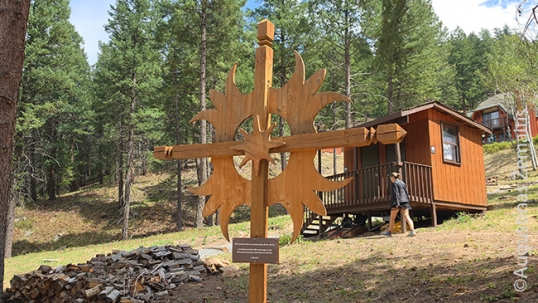
Lithuanian Cross of Colorado
The cross was made by Arvidas Jarašius. Colorado never had a Lithuanian church, club, camp, or cemetery. Therefore, the initial idea was to construct the cross in a public park of Denver but, cross being not just an ethnic tradition but also a Christian religious symbol, this was not permitted by the authorities. An opportunity for a location arose when a Lithuanian priest Francis of Child Jesus Nekrošius, C.S.J., was appointed as the steward of Regina Caeli hermitage.
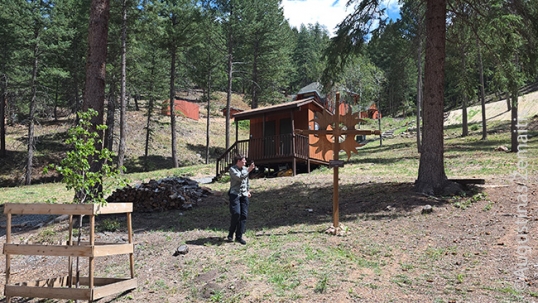
Regina Caeli Hermitage
The hermitage itself is owned by Brothers of St. John who had acquired it from its founder priest Roger Mollison in 2002. It is a secluded natural area filled with a few buildings (for spending a night, meetings) and various walking paths. The Mollison's original purpose for the hermitage was a place for helping teenagers addicted to drugs. Brothers of St. John to purchased the hermitage to have a space for initial formation, as the novices of this order have to spend two months in the so-called "desert" far away from everything. However, now Regina Caeli is primarily used for recollections and as a calm space to stay for Christians, as it includes many Christian symbols, crosses, and spaces to enjoy nature and reflect. The Lithuanian cross near the parking lot is the only ethnic monument.


Comments
- on
- on London, Ontario
- on London, Ontario
- on Toronto, Ontario
- on Toronto, Ontario
Donations
Youtube
Info
- Destination Lithuanian America
- Differences between Lithuanians and neighboring nations
- Divine Mercy: Lithuanian-originated Christian tradition
- Foreign locations named after Lithuania
- Grand Duchy of Lithuania castles abroad
- How to save Lithuanian-American heritage
- Lithuanian camps
- Lithuanian cemeteries abroad
- Lithuanian Churches Abroad
- Lithuanian Convents abroad
- Lithuanian diaspora cuisine
- Lithuanian districts abroad
- Lithuanian Halls abroad
- Lithuanian heritage abroad: what is it?
- Lithuanian minority heritage abroad
- Lithuanian museums abroad
- Lithuanian Schools abroad
- Maps of Lithuanian heritage abroad
- Similarities between Lithuanians and other nations
- Website author Augustinas Žemaitis
- “Lithuanian Landmarks in the USA” book
- Top Lithuanian locations outside Lithuania
- Lithuanian streets and monuments outside Lithuania
Topics
Andrew / Kunta Kinte island Bar Do Vito Sao Paulo Gardinas Palaces Golshiany Palace Grodno Palaces Kengyr Gulag uprising monument Kosava Palace Krėva / Krevo Palace Lida (Lyda) Castle Lida Palace Lithuanian chapel of Washington National Shrine Lithuanian colonies in Africa Lithuanian colony in Gambia Lithuanian consulate general in Latin America Lithuanian district of Sao Paulo Lithuanian embassy in the USA Lithuanian embassy to the European Union Lithuanian Martyrs chapel in Rome Lithuanian migration to Brazil Lithuanian migration to Uruguay Lithuanian shopping malls in Georgia Lithuanians in Bayonne (New Jersey) Lithuanians in Brazil Lithuanians in Jersey City Lithuanians in Kearny (New Jersey) Lithuanians in St. Lawrence (Verano) cemetary Lithuanian Uruguayan cultural society Lituanica (Lithuania) square in New York City Minnesota Lithuanian community Mir (Myras) Castle Navahrudak (Naugardukas) Castle Nesvizh (Nesvyžius) Palace New Jersey St. Paul and St. Peter Lithuanian church Our Lady of Vilnius chapel in Rome Peshchenlag Lithuanian prisoners monument Ruzhany (Ružanai) Palace St. Michael Lithuanian church Bayonne Steplag Lithuanian prisoners monument Transfiguration church in Brooklyn Transfiguration church in Queens Vila Zelina in Sao Paulo Villa Lituania in Rome Vilnius square in Tbilisi (Georgia) Vilnius University model in Mini-Europe park (Brussels) Wilno village in MinnesotaMain sponsors this year:

Department of Cultural Heritage of Lithuania
Lithuanian Foundation, Inc.