Canada
Over the course of some two decades in 1950s-1960s, Lithuanians managed to build an entire „underground Lithuania“ within Canada: a vast network of Lithuanian churches, Lithuanian clubhouses, Lithuanian summer camps, Lithuanian credit unions, even a Lithuanian cemetery, where Lithuanian-Canadian luminaries are buried. Almost the entire public life of a person may pass within that Lithuanian bubble, which includes Lithuanian hunting and angling clubs, Lithuanian Saturday schools, Lithuanian senior residences.
Arguably, nowhere else in the world had Lithuanians built so much in such a short period.
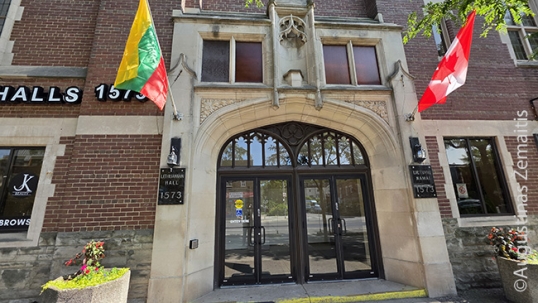
Toronto Lithuanian Hall
Lithuanian heritage rich areas of Canada
Canada hosts 52 000 Lithuanians.
Toronto, ON, is the main hub, with 18 000 living there and in its suburbs alone. The Anapilis Lithuanian Cultural Center of Mississauga may be considered the most extensive Lithuanian hub in the world, as it includes not only a Lithuanian church and secular Lithuanian event halls, but also Canada’s sole Lithuanian Museum-Archive, and even Canada’s only Lithuanian cemetery. Two other Lithuanian-heritage-rich areas are the zone near High Park, where the most historic Lithuanian institutions of Toronto are located, and the Resurrection Lithuanian parish, established in that location in 2001.
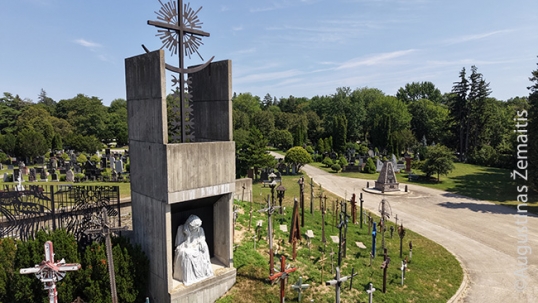
Lithuanian Cemetery and the Hill of Crosses in Mississauga (Toronto area)
Montreal, QC, with some 5 500 Lithuanians, is the second-largest Lithuanian hub, boasting two Lithuanian churches. It is the oldest surviving Lithuanian community in Canada, dating to the 1900s; however, it has declined relatively as the increasing French-language requirements made mostly Lithuanian- and English- speaking Lithuanians leave for other parts of Canada.
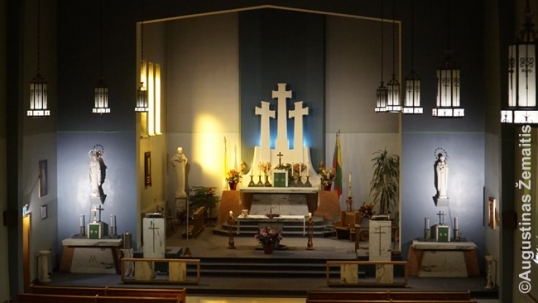
Three Crosses of Vilnius behind the altar of the Montreal Our Lady of Gate of Dawn Lithuanian church
Hamilton, ON, hosts 2 500 Lithuanians and is yet another city where Lithuanians managed to build every type of landmark: here, they have a Lithuanian church, Lithuanian Youth Center (hall), hunters’ and anglers’ club, credit union, and senior residence.
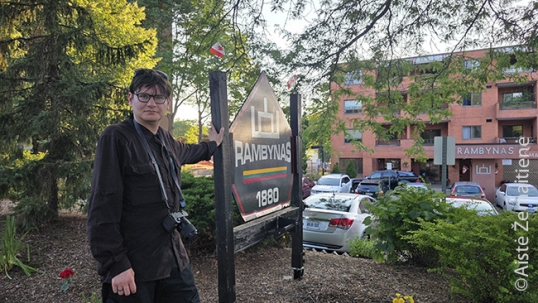
Rambynas Lithuanian Senior Residence
Various smaller cities of southern Ontario – London (1000 Lithuanians), St. Catharines (400), Windsor (400) – also developed Lithuanian communities, each centred around a Lithuanian church, but these churches have closed in the 2000s.

Memorial to Lithuania in St. Catharines
Delhi-Rodney-Tillsonburg area, meanwhile, has few pars in the Americas, as Lithuanians settled to work in farming (tobacco) rather than mines or factories, as was common elsewhere. Lithuanian farms spread across a wide region but Lithuanians would converge for their ethnic activities on several hubs, especially the Lithuanian church of Delhi, ON, but also the Lithuanian club of Rodney. These communities, however, arguably declined the most, as young generations abandoned tobacco farming. The Lithuanian hubs have closed, and only museum exhibits or symbolic plaques in Delhi remind of the community.
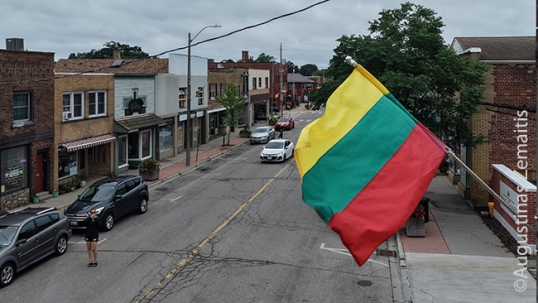
Lithuanian flag in central Delhi
Lithuanian communities on the lakesides north of Toronto began as locations where Lithuanians would spend their summers together. The most fabled is Wasaga Beach, known as “Palanga of Canada”, famous for the world’s longest freshwater beach, where many Lithuanians bought summer residences and even built a Lithuanian church. As more and more Lithuanians relocated there for good, the church became used year-round. Wasaga Beach has numerous houses with Lithuanian décor and streets named in Lithuanian. It also hosts a Lithuanian camp, “Kretinga”. The Lithuanian-Canadian “summer world”, however, does not end with Wasaga Beach: there is another Lithuanian camp – “Romuva” – that stands further north near Huntsville. There are Lithuanian-named streets in Keswick and a Lithuanian monument in Midland.
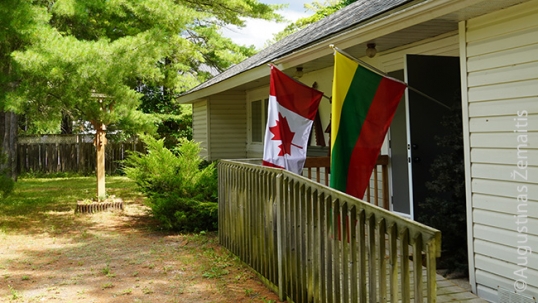
Wasaga Beach Lithuanian Church
Similar lakeside “Lithuanian resorts” have been developed in Quebec by Montreal Lithuanians, who were acquiring lots around pristine lakes that were being opened for development. There, one lake was even named in Lithuanian (Lac Dainava), while three others have Lithuanian monuments or Lithuanian-named places beside them. There was a Lithuanian camp there too; however, it closed.

One of numerous inscriptions where the Lake Dainava name is written
Outside of the “core of Canada” (southern Ontario and southern Quebec), the largest historic Lithuanian hubs are Edmonton, AB (1600 Lithuanians) and Winnipeg, MB (1000). Winnipeg once hosted a neighbourhood with several Lithuanian heritage sites, including a church and a club; however, these have closed as the district became infamous for being unsafe, and it no longer had Lithuanian inhabitants. Meanwhile, Edmonton Lithuanian Home is still doing well, serving both as a secular hall and a chapel, and holding the status of the remotest Lithuanian hub in Canada. Meanwhile, Thunder Bay, ON, never had a large Lithuanian community, but several dozens of Lithuanians who lived there managed to commission one of Canada’s largest Lithuanian monuments in its park, that survives to this day.

Lithuanian Home of Edmonton
Vancouver, BC and Calgary, AB have significant Lithuanian communities but no Lithuanian landmarks, using rented premises for the events. These Lithuanian communities grew in importance recently, due to new immigrants from Lithuania or transmigrants from other parts of Canada.
Nova Scotia may be considered the province where Lithuanian Canada began and did so twice – once in the 1900s, when Lithuanians from Scotland migrated to work in the coal mines and smelter of Sydney Mines, and then again in the 1940s-1950s, when the post-WW2 Lithuanian migrants used Halifax as their main entry port. However, besides the exhibits at Halifax “Pier 21” museum, little Lithuanian survives there.

Pier 21 museum
Underground Lithuania of the DPs (1940s)
This "Underground Lithuania" of Canada was developed by a single generation of Lithuanian immigrants with very similar family histories. They had fled Lithuania in a few weeks in 1944, just before the Soviets reoccupied it. Known as DPs – or displaced persons – after fleeing the frontline across the continent, they were eventually settled into numerous DP camps in West Germany, Denmark, and elsewhere. There were a total of 80 000 Lithuanians among the DPs. Initially, they hoped to return to Lithuania once it was liberated – but with prolonged Soviet occupation dashing these hopes, various countries of the world began resettling DPs in their own lands. Among those countries was Canada.
USA accepted the largest number of Lithuanian DPs; however, US immigration policies were more restrictive, and Lithuanians who had no Lithuanian-American relatives often found it harder to get an invitation there. Canada, on the other hand, accepted the DPs more openly – as long as they worked one year in government-designated sites after the immigration. Thus, in 1947-1953, some 12 000 of Lithuanian DPs followed a similar pattern of resettlement: leaving their DP camps in Western Europe for good, travelling by ship to Halifax, and then to their worksites, often in far-away places such as Noranda Mines, QC, railway construction, and woodcutting. After the mandatory work year, they would move to the main cities of Canada: Toronto, Montreal, Hamilton, London, Windsor, St. Catharines, and Winnipeg, Edmonton.
The DPs considered themselves to be exiles rather than emigrants, as they would have never left Lithuania if not for the inevitable occupation and genocide – many already knew they would be targets for persecution. Thus, they were especially inclined to build “Little Lithuanias” in their new hometowns. Typically, the largest one among those would be the Lithuanian church, as Lithuanian parishes also served as the main hubs for secular ethnic activities, such as the heritage schools where DP children would be taught Lithuanian language and culture. In the smaller communities, that was it, but for the larger ones, the church was joined by Lithuanian halls, Lithuanian credit unions, Lithuanian senior residences, Lithuanian hunters’ and anglers’ clubs and more.

A fragment of the Lithuanian soldier stained-glass window in Hamilton Lithuanian chruch extension
In the pretty countrysides and lakesides, the Lithuanian DPs of Canada established Lithuanian camps, so their children could spend at least a couple of weeks every summer surrounded by other Lithuanian kids (and possibly meeting their significant other there). Over time, Lithuanians acquired summer residences in similar areas, and some moved there for good later.
In the cities, Lithuanians campaigned to have streets, parks, and other locations named after Lithuania and its cities, to remind Canadians of the Soviet occupation of Lithuania, that continued until 1990.
Early Lithuanians in Canada (1900s-1930s)
While much of what is visibly Lithuanian in today’s Canada was created by the DPs, the first Lithuanian communities in Canada formed in the early 1900s in Montreal and Sydney Mines. In that era, however, immigration to the USA was almost unrestricted, so most Lithuanians chose that country, with just a couple of thousand coming to Canada, many of those indirectly (after spending some time in Scotland or elsewhere).
The early Lithuanian-Canadian community began growing more rapidly after World War I, when USA curtailed immigration and Lithuanians had to seek new areas for their “American dream”. Tobacco farms of Delhi, Toronto, and Winnipeg became some of those areas (together with Brazil, Argentina, and Uruguay).
Little visible landmarks remain from that era, however: as the huge numbers of DPs arrived after World War II, they essentially took over the few Lithuanian pre-WWII hubs that existed and rebuilt them. For example, there were two Lithuanian churches in Canada in the 1920s (Toronto and Montreal). Both parishes continued to exist, but were relocated into new, larger, post-WWII buildings.
Other pre-WWII Lithuanian institutions were leftist, creating a rift between them and the DPs, who were fleeing the leftist Soviet Union. Some of those have slowly declined and disappeared.
Later Lithuanians in Canada (after 1950s)
In 1944, the Soviet Union, having occupied Lithuania, blocked emigration to the West. Those who did not manage to leave with the earlier DP wave were all but trapped behind the Iron Curtain.
Of those, the more “fortunate” ones spent their lives in occupied Lithuania, while others were deported to Siberia, Kazakhstan, and other areas with harsh climates. However, Lithuanians continued to immigrate to Canada little by little, though not from Lithuania itself, but rather from Poland, namely the Suwałki (Lithuanian: Suvalkai), Puńsk (Punskas), and Sejny (Seinai) areas that have Lithuanian villages since prehistoric times. This was possible as Poland, while also ruled by a communist regime, was not part of the Soviet Union, and it did not ban westward emigration.
For those Lithuanians, Canada became the primary “land of dreams” in the postwar period. Although no more than a few thousand Lithuanians from Poland’s Lithuanian regions immigrated to Canada, that community is particularly visible: having grown accustomed to preserving their Lithuanian identity through hardship as a minority in Poland, they took great care to preserve their Lithuanian culture—and the Lithuanian landmarks—in Canada as well.
In 1990, Lithuania regained independence by breaking away from the Soviet Union, and restrictions on emigration were lifted. Hundreds of thousands of Lithuanians left their country, as its economy had been ravaged by decades of Communism. While many chose the United States or Western Europe, some 6,000 also came to Canada. In Toronto, Edmonton, and Wasaga Beach, many of them joined Lithuanian DP organizations and continued to cherish the Lithuanian landmarks created by the DPs.
In other respects, the paths of the new Lithuanian Canadians and the DPs diverged: many modern emigrants settled in the growing western Canadian cities of Vancouver and Calgary, where they found no Lithuanian buildings or monuments, so their Lithuanian activities take place in rented spaces.
Meanwhile, Montréal and Hamilton, once major hubs of the DP community, received fewer new Lithuanians; moreover, many DPs moved away from Montréal because of stricter requirements for French-language proficiency. As a result, it seems as though it became harder for Lithuanian landmarks in these regions to survive than it was in Toronto.
The map of Lithuanian-Canadian sites
All the Lithuanian-Canadian locations are marked on this interactive map, made by the "Destination Lithuanian America" expedition (click the link):


Comments
- on Germany
- on
- on London, Ontario
- on London, Ontario
- on Toronto, Ontario
Donations
Youtube
Info
- Destination Lithuanian America
- Differences between Lithuanians and neighboring nations
- Divine Mercy: Lithuanian-originated Christian tradition
- Foreign locations named after Lithuania
- Grand Duchy of Lithuania castles abroad
- How to save Lithuanian-American heritage
- Lithuanian camps
- Lithuanian cemeteries abroad
- Lithuanian Churches Abroad
- Lithuanian Convents abroad
- Lithuanian diaspora cuisine
- Lithuanian districts abroad
- Lithuanian Halls abroad
- Lithuanian heritage abroad: what is it?
- Lithuanian minority heritage abroad
- Lithuanian museums abroad
- Lithuanian Schools abroad
- Maps of Lithuanian heritage abroad
- Similarities between Lithuanians and other nations
- Website author Augustinas Žemaitis
- “Lithuanian Landmarks in the USA” book
- Top Lithuanian locations outside Lithuania
- Lithuanian streets and monuments outside Lithuania
Topics
Andrew / Kunta Kinte island Bar Do Vito Sao Paulo Gardinas Palaces Golshiany Palace Grodno Palaces Kengyr Gulag uprising monument Kosava Palace Krėva / Krevo Palace Lida (Lyda) Castle Lida Palace Lithuanian chapel of Washington National Shrine Lithuanian colonies in Africa Lithuanian colony in Gambia Lithuanian consulate general in Latin America Lithuanian district of Sao Paulo Lithuanian embassy in the USA Lithuanian embassy to the European Union Lithuanian Martyrs chapel in Rome Lithuanian migration to Brazil Lithuanian migration to Uruguay Lithuanian shopping malls in Georgia Lithuanians in Bayonne (New Jersey) Lithuanians in Brazil Lithuanians in Jersey City Lithuanians in Kearny (New Jersey) Lithuanians in St. Lawrence (Verano) cemetary Lithuanian Uruguayan cultural society Lituanica (Lithuania) square in New York City Minnesota Lithuanian community Mir (Myras) Castle Navahrudak (Naugardukas) Castle Nesvizh (Nesvyžius) Palace New Jersey St. Paul and St. Peter Lithuanian church Our Lady of Vilnius chapel in Rome Peshchenlag Lithuanian prisoners monument Ruzhany (Ružanai) Palace St. Michael Lithuanian church Bayonne Steplag Lithuanian prisoners monument Transfiguration church in Brooklyn Transfiguration church in Queens Vila Zelina in Sao Paulo Villa Lituania in Rome Vilnius square in Tbilisi (Georgia) Vilnius University model in Mini-Europe park (Brussels) Wilno village in MinnesotaMain sponsors this year:

Department of Cultural Heritage of Lithuania

Lithuanian Foundation, Inc.
Leave a comment